Descrição do produto
Machining Capability
Our Gear, Pinion Shaft, Ring Gear Capabilities:
| Capabilities of Gears/ Splines | ||||||
| Item | Internal Gears and Internal Splines | External Gears and External Splines | ||||
| Milled | Shaped | Ground | Hobbed | Milled | Ground | |
| Max O.D. | 2500 mm | |||||
| Min I.D.(mm) | 30 | 320 | 20 | |||
| Max Face Width(mm) | 500 | 1480 | ||||
| Max DP | 1 | 0.5 | 1 | 0.5 | ||
| Max Module(mm) | 26 | 45 | 26 | 45 | ||
| DIN Class Level | DIN Class 8 | DIN Class 4 | DIN Class 8 | DIN Class 4 | ||
| Tooth Finish | Ra 3.2 | Ra 0.6 | Ra 3.2 | Ra 0.6 | ||
| Max Helix Angle | ±22.5° | ±45° | ||||
Our Main Products
1. Spur Gear
2. Planetary Gear
3. Metal Gears
4. Gear Wheel
5. Ring Gear
6. Gear Shaft
7. Helical Gear
8. Pinion Gear
9. Spline Shaft
perfil de companhia
1. 21 years experience in high quality gear, gear shaft’s production, sales and R&D.
2. Our Gear, Gear Shaft are certificated by ISO9001: 2008 and ISO14001: 2004.
3. CHINAMFG has more than 50 patents in high quality Gear, Gear Shaft manufacturing.
4. CHINAMFG products are exported to America, Europe.
5. Experience in cooperate with many Fortune 500 Companies
Nossas vantagens
1) In-house capability: OEM service as per customers’ requests, with in-house tooling design & fabricating
2) Professional engineering capability: On product design, optimization and performance analysis
3) Manufacturing capability range: DIN 3960 class 8 to 4, ISO 1328 class 8 to 4, AGMA 2000 class 10-15, JIS 1702-1703 class 0 to 2, etc.
4) Packing: Tailor-made packaging method according to customer’s requirement
5) Just-in-time delivery capability
Perguntas frequentes
1. Q: Can you make as per custom drawing?
A: Yes, we can do that.
2. Q: If I don’t have drawing, what can you do for me?
A: If you don’t have drawing, but have the sample part, you may send us. We will check if we can make it or not.
3. Q: How do you make sure the quality of your products?
A: We will do a series of inspections, such as:
A. Raw material inspection (includes chemical and physical mechanical characters inspection),
B. Machining process dimensional inspection (includes: 1st pc inspection, self inspection, final inspection),
C. Heat treatment result inspection,
D. Gear tooth inspection (to know the achieved gear quality level),
E. Magnetic particle inspection (to know if there’s any cracks in the gear).
We will provide you the reports 1 set for each batch/ shipment.
| Aplicativo: | Wind Turbine |
|---|---|
| Dureza: | Superfície dentária endurecida |
| Posição da marcha: | External Gear |
| Personalização: |
Disponível
| Solicitação personalizada |
|---|
.shipping-cost-tm .tm-status-off{background: none;padding:0;color: #1470cc}
|
Custo do frete:
Frete estimado por unidade. |
sobre o custo do frete e o prazo estimado de entrega. |
|---|
| Método de pagamento: |
|
|---|---|
|
Pagamento inicial Pagamento integral |
| Moeda: | US$ |
|---|
| Devoluções e reembolsos: | Você pode solicitar um reembolso em até 30 dias após o recebimento dos produtos. |
|---|
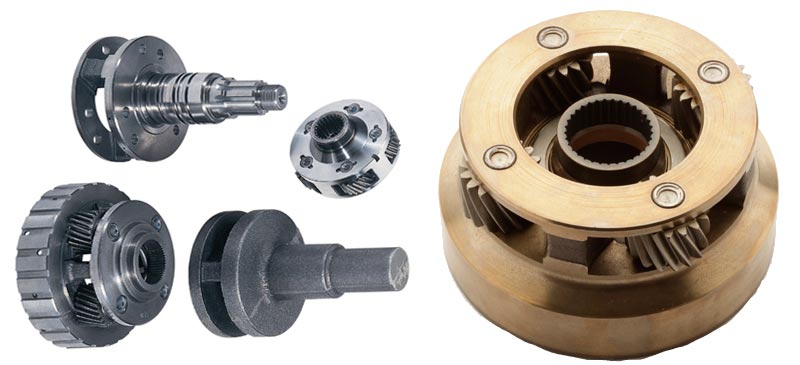
How do you calculate the gear ratio involving sun, planet, and ring gears?
The gear ratio in a planetary gear system can be calculated by considering the number of teeth on the sun gear, planet gears, and ring gear. The gear ratio determines the relationship between the input speed and the output speed of the system. Here’s how you can calculate the gear ratio:
- Step 1: Count the Teeth:
Count the number of teeth on the sun gear (S), the planet gears (P), and the ring gear (R). These numbers represent the respective gear’s tooth count.
- Step 2: Determine the Gear Arrangement:
Identify the gear arrangement. In a simple planetary gear system, the sun gear is at the center, surrounded by planet gears, and enclosed by the ring gear.
- Step 3: Calculate the Gear Ratio:
The gear ratio (GR) can be determined using the formula:
GR = (R + P) / S
Where:
- R represents the number of teeth on the ring gear
- P represents the number of teeth on the planet gears (assuming they have the same number of teeth)
- S represents the number of teeth on the sun gear
The resulting gear ratio represents the speed relationship between the input and output of the planetary gear system. A gear ratio greater than 1 indicates a speed reduction, while a gear ratio less than 1 indicates a speed increase.
It’s important to note that in more complex planetary gear systems, where there are multiple sets of planet gears or additional gears, the calculation of the gear ratio may involve considering multiple gear stages and their respective tooth counts.
In summary, to calculate the gear ratio involving sun, planet, and ring gears, you need to count the teeth on each gear and use the formula (R + P) / S, where R is the number of teeth on the ring gear, P is the number of teeth on the planet gears, and S is the number of teeth on the sun gear. This calculation provides the gear ratio that defines the speed relationship between the input and output of the planetary gear system.
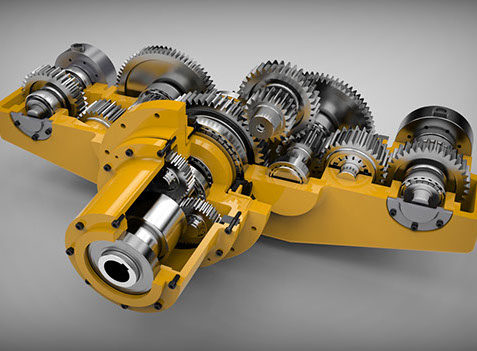
Engrenagens planetárias podem ser usadas em aplicações aeroespaciais e de aviação?
As engrenagens planetárias são amplamente utilizadas em aplicações aeroespaciais e de aviação devido às suas características e vantagens únicas. Vamos explorar como as engrenagens planetárias podem ser utilizadas na indústria aeroespacial e de aviação:
- Motores de aeronaves:
As engrenagens planetárias desempenham um papel crucial nos motores de aeronaves, especialmente na caixa de redução. A caixa de redução conecta o eixo da turbina de alta velocidade ao eixo da hélice de baixa velocidade, permitindo a transmissão eficiente de potência e mantendo a velocidade ideal da hélice. As engrenagens planetárias dentro da caixa de redução ajudam a alcançar as relações de transmissão e a conversão de torque necessárias, garantindo uma operação suave e confiável do motor.
- Sistemas de trem de pouso:
Engrenagens planetárias também são utilizadas em sistemas de trem de pouso de aeronaves. Essas engrenagens fornecem o torque e a força necessários para retrair e estender o trem de pouso durante a decolagem e o pouso. As engrenagens planetárias oferecem compacidade, alta capacidade de torque e a capacidade de suportar cargas pesadas, tornando-as adequadas para essa aplicação crítica.
- Sistemas de atuação:
Os sistemas de atuação na indústria aeroespacial e de aviação, como os utilizados em superfícies de controle de voo, também se beneficiam do uso de engrenagens planetárias. Essas engrenagens permitem o movimento preciso e confiável de superfícies de controle, como ailerons, profundores e lemes. A capacidade das engrenagens planetárias de suportar altos torques, proporcionar posicionamento preciso e resistir a cargas variáveis as torna ideais para sistemas de atuação.
- Mecanismos de satélites e espaçonaves:
Em aplicações de satélites e espaçonaves, as engrenagens planetárias são utilizadas em diversos mecanismos. Elas podem ser encontradas em acionamentos de painéis solares, sistemas de apontamento de antenas e mecanismos de implantação de instrumentos científicos. As engrenagens planetárias oferecem compacidade, alta transmissão de torque e a capacidade de suportar as condições extremas dos ambientes espaciais.
- Unidades de Potência Auxiliar (APUs):
As APUs (Unidades Auxiliares de Potência) em aeronaves são responsáveis por fornecer energia auxiliar durante operações em solo e emergências em voo. Engrenagens planetárias são frequentemente empregadas em sistemas de APU para transferir energia do motor para os sistemas auxiliares, como geradores elétricos ou bombas hidráulicas. Essas engrenagens garantem a transmissão eficiente de energia e a operação confiável da APU.
Em resumo, as engrenagens planetárias têm aplicações significativas nas indústrias aeroespacial e de aviação. Elas são utilizadas em motores de aeronaves, sistemas de trem de pouso, sistemas de atuação, mecanismos de satélites e espaçonaves, bem como em unidades de potência auxiliares. O tamanho compacto, a alta capacidade de torque, o posicionamento preciso e a operação confiável das engrenagens planetárias as tornam ideais para essas aplicações críticas na indústria aeroespacial e de aviação.
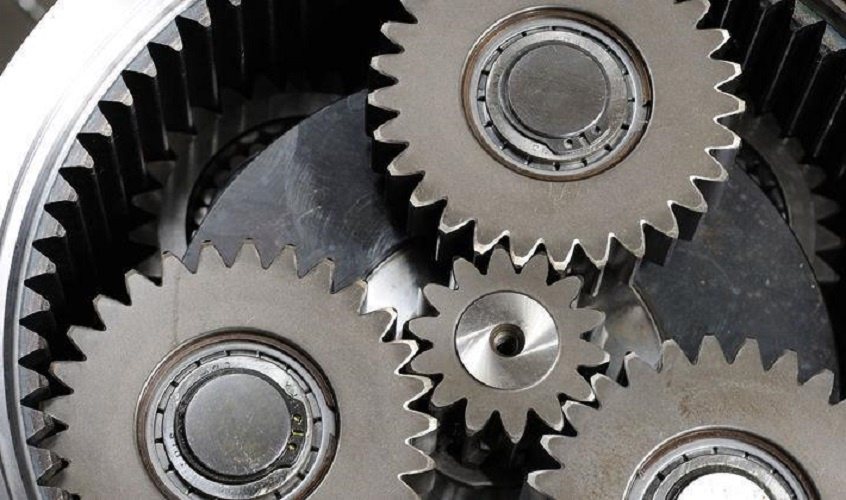
Can you describe the role of sun gears, planet gears, and ring gears in planetary systems?
In a planetary gear system, each component—the sun gear, planet gears, and ring gear—plays a crucial role in the overall operation and functionality. Let’s explore the roles of these gears:
- Sun Gear:
The sun gear is a central component in a planetary gear system. It is typically located at the center and is driven by an input source such as a motor or engine. The sun gear receives the input power and transmits it to the other gears in the system. As the sun gear rotates, it drives the rotation of the planet gears, which, in turn, contribute to the overall gear operation. The size and number of teeth on the sun gear determine the gear ratio and torque characteristics of the system.
- Planet Gears:
The planet gears are gears that surround the sun gear in a planetary gear system. They are typically smaller in size compared to the sun gear and are connected to a carrier or arm. The planet gears mesh with both the sun gear and the ring gear. As the sun gear rotates, it drives the rotation of the planet gears. The planet gears exhibit both rotational and orbital motion. While they rotate on their own axes, they also orbit around the sun gear. This combination of rotational and orbital movement allows the planet gears to transmit torque and contribute to the overall gear reduction or amplification. The arrangement and number of planet gears can vary depending on the specific design and requirements of the system.
- Ring Gear:
The ring gear is the outermost gear in a planetary gear system. It has internal teeth that mesh with the planet gears. The ring gear remains fixed or stationary while the sun gear and planet gears rotate. The interaction between the planet gears and the ring gear enables the gear system to achieve gear reduction or amplification. The size and number of teeth on the ring gear also influence the gear ratio and torque characteristics of the system.
In summary, the sun gear serves as the primary driver, receiving the input power and transmitting it to the other gears. The planet gears rotate and orbit around the sun gear, contributing to torque transmission and gear functionality. The ring gear remains fixed and meshes with the planet gears, allowing for gear reduction or amplification. Together, these gears work in harmony to achieve the desired gear ratios, torque transmission, and overall operation of planetary gear systems.


editor by CX 2023-11-02