Opis produktu
48v 80ZYT Brush Pm DC Planetary Gear Motor table fan motor for Door Opener
Quiet, stable and reliable for long life operation
1.Diameters: 80mm
2.Lengths: 108mm;128mm;148mm
3.Continuous torques: 0.50Nm;0.82Nm;0.65Nm
4.Power: 106W;180W;140W
5.Speeds up to 2030rpm;2100rpm;2050rpm
6.Environmental conditions: -10~+40°C
7.Number of poles:4
8.Mangnet material:Hard Ferrit
9.Insulation class:B
10.Optional: electronic drivers, encoders and gearheads, as well as Hall effect resolver and sensorless feedback
11.We can design the special voltage and shaft, and so on
| Model | 80ZYT4-01 | 80ZYT4-02 | 80ZYT4-03 | |
| Voltage | V | 24 | ||
| No load speed | obr./min | 2380 | 2460 | 2390 |
| Rated torque | Nm | 0.50 | 0.82 | 1.10 |
| Rated speed | obr./min | 2030 | 2100 | 2050 |
| Rated current | A | 6.5 | 10.7 | 14.0 |
| Stall torque | Nm | 3.40 | 5.58 | 7.90 |
| Stall current | A | 37.4 | 63.2 | 84.6 |
| Rotor inertia | Kgmm² | 420 | 550 | 700 |
| Back-EMF constant | V/krpm | 9.8 | 9.5 | 9.8 |
| Torque Constant | Nm/A | 0.571 | 0. 0571 | 0.571 |
| Resistance(20ºC) | ohm | 0.65 | 0.38 | 0.28 |
| Waga | Kg | 1.7 | 2.0 | 2.3 |
| L1 | mm | 108 | 128 | 148 |
| Rotor:La | mm | 30 | 50 | 70 |
Normal type of shaft
| Aplikacja: | Universal, Industrial, Household Appliances, Car, Power Tools, Medical Equpiments |
|---|---|
| Operating Speed: | Constant Speed |
| Excitation Mode: | Compound |
| Function: | Driving |
| Number of Poles: | 2 |
| Structure and Working Principle: | Brush |
| Próbki: |
US$ 28/Piece
1 sztuka (minimalne zamówienie) | |
|---|
| Personalizacja: |
Dostępny
| Spersonalizowane żądanie |
|---|
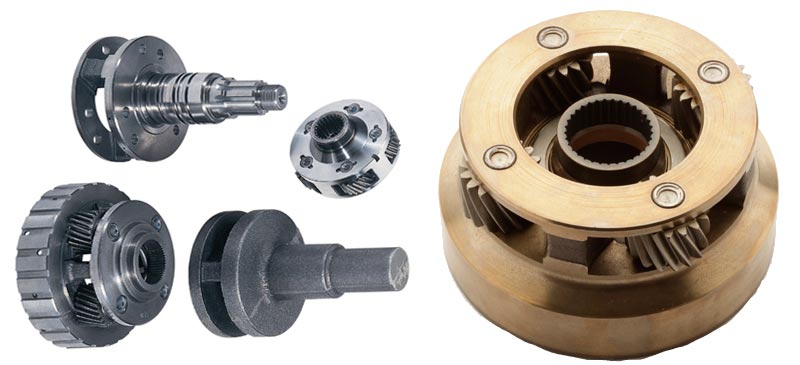
Jak obliczyć przełożenie przekładni obejmującej koła słoneczne, planetarne i pierścieniowe?
Przełożenie w układzie przekładni planetarnej można obliczyć, uwzględniając liczbę zębów koła słonecznego, kół planetarnych i pierścienia zębatego. Przełożenie określa zależność między prędkością wejściową a prędkością wyjściową układu. Oto jak można obliczyć przełożenie:
- Krok 1: Policz zęby:
Policz liczbę zębów na kole słonecznym (S), kołach planetarnych (P) i kole pierścieniowym (R). Liczby te oznaczają liczbę zębów danego koła.
- Krok 2: Określ układ przekładni:
Określ układ kół zębatych. W prostym układzie przekładni planetarnej koło słoneczne znajduje się w środku, otoczone kołami planetarnymi i zamknięte kołem pierścieniowym.
- Krok 3: Oblicz przełożenie:
Przełożenie przekładni (GR) można określić korzystając ze wzoru:
GR = (R + P) / S
Gdzie:
- R reprezentuje liczbę zębów koła zębatego pierścieniowego
- P reprezentuje liczbę zębów na kołach planetarnych (zakładając, że mają taką samą liczbę zębów)
- S oznacza liczbę zębów koła słonecznego
Wynikowy współczynnik przełożenia reprezentuje zależność prędkości między wejściem a wyjściem układu przekładni planetarnej. Współczynnik większy niż 1 oznacza redukcję prędkości, a współczynnik mniejszy niż 1 oznacza jej wzrost.
Należy pamiętać, że w bardziej złożonych układach przekładni planetarnych, w których występuje wiele zestawów kół planetarnych lub dodatkowych kół zębatych, obliczenie przełożenia może wymagać uwzględnienia wielu stopni przekładni i odpowiadającej im liczby zębów.
Podsumowując, aby obliczyć przełożenie przekładni zębatej obejmującej koło słoneczne, planetarne i pierścieniowe, należy policzyć zęby każdego koła i skorzystać ze wzoru (R + P) / S, gdzie R to liczba zębów koła pierścieniowego, P to liczba zębów kół planetarnych, a S to liczba zębów koła słonecznego. To obliczenie pozwala uzyskać przełożenie, które definiuje zależność prędkości między wejściem a wyjściem układu przekładni planetarnej.
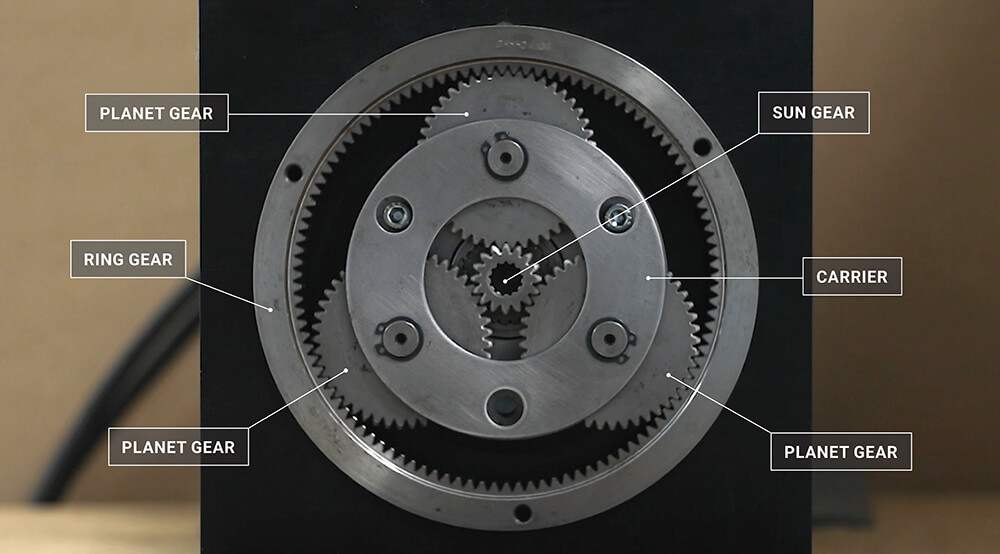
How do planetary gears handle variations in direction and torque transmission?
Planetary gears are versatile mechanisms that can effectively handle variations in direction and torque transmission. Let’s explore how they achieve this:
- Direction Reversal:
Planetary gears are capable of transmitting torque in both forward and reverse directions. By changing the input and output connections, the direction of rotation can be reversed without the need for additional components or complex mechanisms. This makes planetary gears well-suited for applications where frequent changes in direction are required, such as automotive transmissions.
- Torque Amplification and Reduction:
One of the notable characteristics of planetary gears is their ability to amplify or reduce torque depending on the arrangement of gear components. Let’s consider a basic arrangement with a sun gear, planet gears, and a ring gear:
- Wzmocnienie momentu obrotowego:
When the sun gear is the input and the ring gear is the output, the planet gears rotate on their own axes while also revolving around the sun gear. This arrangement allows for torque amplification, meaning the output torque can be higher than the input torque. This is particularly useful in applications where higher torque is required, such as heavy machinery or power transmission systems.
- Torque Reduction:
Conversely, by fixing the ring gear and using the sun gear as the output, the planet gears rotate on their own axes while also revolving around the fixed ring gear. In this configuration, the output torque is lower than the input torque, enabling torque reduction. This can be advantageous in applications where torque needs to be reduced, such as speed reduction systems or precision machinery.
- Combination of Gear Stages:
Planetary gears can be combined into multiple stages, with each stage having its own set of sun gears, planet gears, and ring gears. This arrangement allows for further variations in torque transmission. By connecting the output of one stage to the input of another, the torque can be further amplified or reduced, providing flexibility in power transmission systems.
- Custom Gear Ratios:
By selecting the appropriate sizes and numbers of teeth for the sun gears, planet gears, and ring gears, custom gear ratios can be achieved in planetary gear systems. This allows for precise control over torque transmission and enables the adaptation of the gear arrangement to specific application requirements.
In summary, planetary gears handle variations in direction and torque transmission through their ability to reverse direction without additional components, torque amplification or reduction based on gear arrangement, combination of multiple gear stages, and the ability to achieve custom gear ratios. These features make planetary gears a versatile choice for a wide range of applications requiring efficient and flexible power transmission.
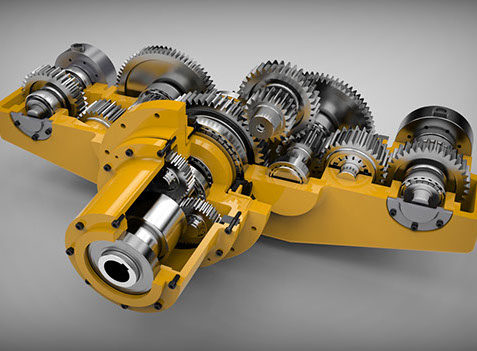
What is the purpose of using planetary gears in machinery?
Planetary gears serve several important purposes in machinery and mechanical systems. Let’s delve into the key purposes and benefits of using planetary gears:
- Zmiana przełożenia:
One of the primary purposes of planetary gears is to achieve different gear ratios. By varying the number of teeth on the sun gear, planet gears, and ring gear, a wide range of gear ratios can be obtained. This flexibility enables machinery to adapt to varying speed and torque requirements, allowing for precise control and efficient power transmission.
- Wzmocnienie momentu obrotowego:
Planetary gears are known for their ability to amplify torque. The arrangement of multiple gear sets in a compact design allows for torque multiplication. This can be particularly beneficial in applications where high torque is required while maintaining a smaller form factor. Planetary gears can efficiently transmit torque and handle heavy loads.
- Compact Size:
Another advantage of planetary gears is their compact size. The internal gear meshing and the integration of multiple gear sets within a single gear system contribute to their space-saving design. This compactness is valuable in machinery where space constraints are a consideration, enabling the design of more compact and lightweight systems.
- High Efficiency:
Planetary gears are known for their high efficiency in power transmission. The internal gear meshing and the distribution of load across multiple gear teeth result in efficient torque transfer with minimal power loss. This efficiency is crucial in machinery where energy conservation and optimization are important factors.
- Directional Control:
Planetary gears allow for bidirectional power transmission. By controlling the direction of rotation of the input and output elements, the direction of rotation in the machinery can be easily changed. This feature is useful in applications that require reversing the direction of rotation or changing the rotational direction without the need for additional mechanisms.
- Shock Absorption:
The arrangement of multiple gears in a planetary gear system provides inherent shock-absorbing capabilities. The distributed load between the gear teeth helps to dampen vibrations and absorb shocks, contributing to smoother operation and reduced wear on the system components.
- Application Versatility:
Planetary gears find applications in a wide range of machinery and mechanical systems. They are commonly used in automotive transmissions, industrial machinery, robotics, aerospace systems, power generation equipment, and more. The versatility of planetary gears stems from their ability to provide precise control, compactness, high torque transmission, and efficient power transmission.
In summary, the purpose of using planetary gears in machinery is to achieve variable gear ratios, amplify torque, maintain compact size, ensure high efficiency in power transmission, enable bidirectional control, absorb shocks, and provide versatility for various applications. The unique characteristics of planetary gears make them valuable components in diverse machinery and mechanical systems.


editor by CX 2023-11-02